
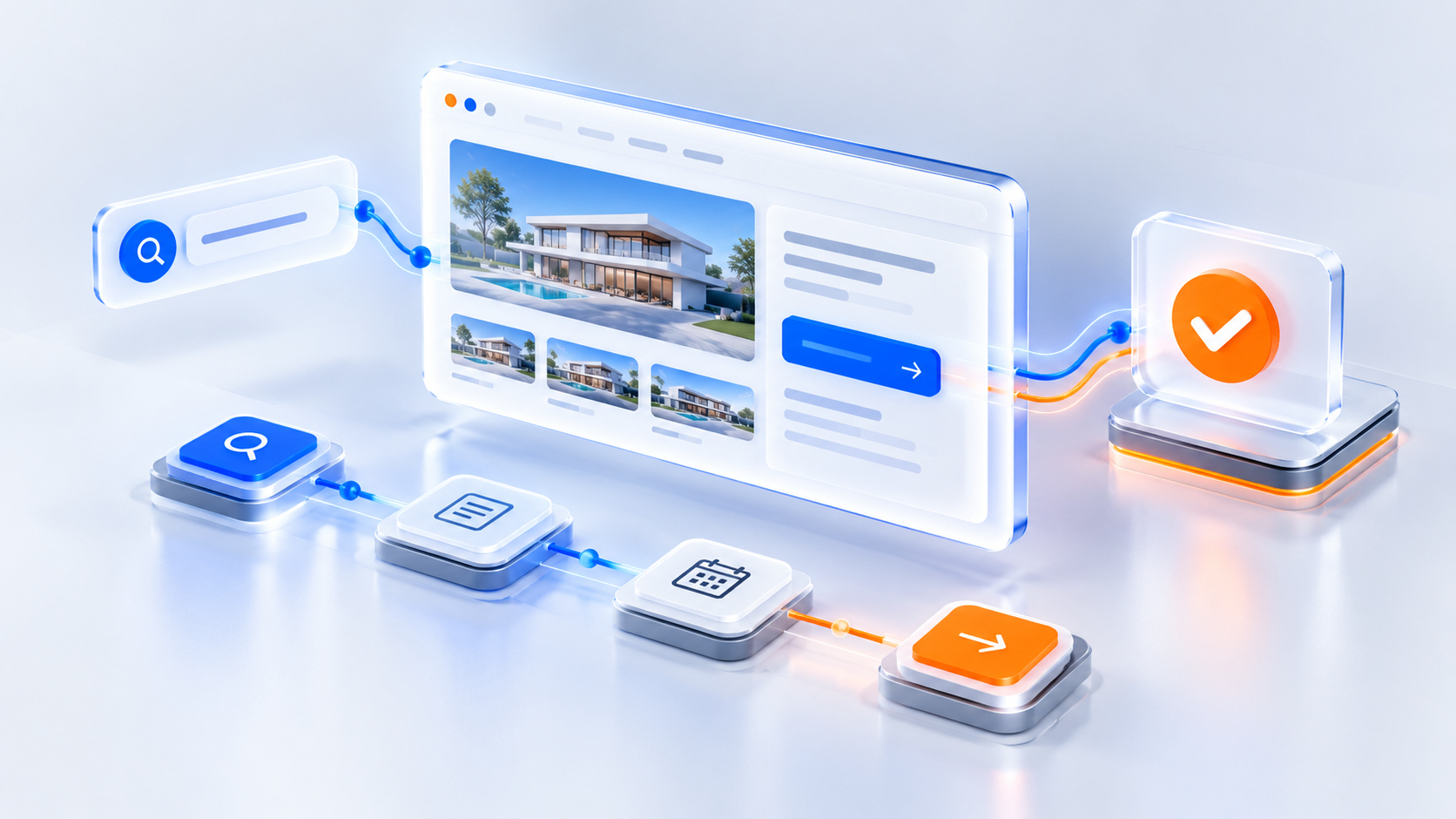
Purpose of a Website: Delivering Value Through Usability
The purpose of a website is to make the business usable. Most websites were built to describe the business. They explain who the company is, list what it offers and then send the customer to a phone number, email address or contact form. The actual work begins somewhere else.
A property is displayed, but the viewing cannot be booked. A vehicle is promoted, but local stock and price remain unclear. A flight is sold, but the passenger has to manage the rest of the journey across disconnected interfaces.
The website does not need to run the entire business. It needs to make the right capability available at the right moment.
What Is the Purpose of a Website?
The traditional purpose of a business website was to inform, build trust and generate a lead. A modern business website still performs those functions, but its role extends beyond a marketing asset.
The role of a website in business now has three parts:
- show the real offer,
- help the customer make a decision and
- enable the next step.
If it only informs, most of the customer journey still happens outside the experience. The stronger question is no longer what the website should say. It is what someone should be able to accomplish through it. In simple terms: A modern website turns business capability into customer capability.
Being Found Is Only the Entrance
How businesses are discovered has already changed. The Future of SEO examines that shift across search and AI interfaces. But being found is not the same as being understood.
Websites for Humans and AI explains how business knowledge becomes clear to people and machines. Discovery and understanding are the entrance.
The next responsibility is usability. This article addresses what happens when someone reaches the business and wants to act. The business has been found. The offer has been understood. What can the customer do now? If the answer is limited to “contact us”, the journey still ends before the business becomes useful. Traffic cannot fix that. More content cannot fix it either. The website has to turn information into a usable path.
The Website Should Not End Where the Work Begins
Large organisations can run sophisticated systems for inventory, compliance, pricing and service delivery and still provide a poor customer experience. A powerful backend creates potential. It does not automatically turn that potential into something the customer can use.
Consider a cinema website. The business may already have live showtimes, seat inventory and payment processing. If the visitor cannot find the button to buy a ticket, none of that capability matters at the customer touchpoint. The same failure becomes more expensive as the business grows. The data exists. The process exists. The team can deliver. But the website stops precisely where customer intent becomes valuable.
More backend does not solve that problem. A better connection does.
Start With a Task, Build the Path Around It
Every business can perform tasks: price, advise, reserve, deliver, finance, recruit, approve, match or support. A modern website exposes the right capability through a clear customer path. Do not begin with pages. Begin with the task.
Define the Outcome
A customer rarely visits a website because they want to explore its structure. They want to compare a property, buy a ticket, find an available vehicle, book an appointment or apply for a role. Name that outcome first. Then determine which information, decision and business capability it requires. This is the foundation of a useful business website strategy.
Connect It to the Real Business
The website should show the business as it operates now. A reserved property should not appear available. A closed vacancy should not continue collecting applications. A vehicle advertised at one location should not disappear when the customer asks for a test drive. Not every page needs live data. But every decision-critical fact — price, availability, requirements, timing or location — needs a reliable source and an update path.
Keep the Context Moving
When the customer acts, the context should move with them. A viewing request should identify the property and preferred time. A test-drive booking should include the vehicle, configuration and dealership. A job application should remain connected to the role. Many websites capture a lead and discard the journey that created it. The customer repeats information. The team reconstructs the request. Time is lost on both sides. Start with a task. Connect the capability. Keep the context.
One Question Reveals Whether a Website Is Modern
Not how many pages it contains. Not how many tools are connected. Not whether it uses AI. What useful outcome can a person achieve without rebuilding the context somewhere else?
A practical review should test four points:
- Can someone reach a real offer rather than a generic description?
- Can they determine whether that offer is relevant and available?
- Can they complete or meaningfully begin the next task?
- Does their context reach the correct process or person?
If every journey ends with “contact us”, the website may be collecting leads. It is not yet giving customers access to the business behind it.
The Website Is the Operating Layer, Not the Entire Stack
A website as an operating system does not mean that the CMS should replace the CRM, ERP, booking platform or every specialist tool inside the company. It means the website becomes the public operating layer between customer intent and business execution. The systems underneath can remain specialised. At the surface, the customer should experience one coherent path.
The business decision is simpler: identify the task, connect the required capabilities and make them work as one experience.
The Goal Is Not to Remove People
Automation should remove repetition, not responsibility. The website can collect structured information, show current options and prepare the context. People enter where judgement, advice, exceptions and relationships create value. The goal is not fewer human interactions. It is fewer unnecessary ones.
Measure what the website enables — page views and traffic show attention, leads and conversion rates show response. Neither alone proves that the website is performing a useful business function. A website designed around customer capability should also measure:
- Task availability: How many important customer tasks can be completed or meaningfully started online?
- Task completion: Where do people abandon a booking, purchase, application or request?
- Information accuracy: How often do outdated prices, availability or conditions create errors?
- Handover quality: Does the correct context reach the responsible system or person?
- Time to outcome: Does the website shorten the distance between customer need and business response?
These measures reveal whether the website is simply attracting demand or helping the business serve it.
Conclusion: Make the Business Usable
So, what is the purpose of a website? Not to contain more pages, connect more tools or automate everything. It is to give customers a usable path into the business. Do not begin with a redesign. Begin with one important customer task. Connect it to real information. Carry the context into the operation. Then add the next capability.
FAQ
What is the main purpose of a business website?
The main purpose of a business website is to connect a customer need with a useful outcome. It should make the real offer clear, support a decision and pass the next action into the correct business process.
Does every modern website need real-time data?
No. Real-time integration matters when information changes frequently and directly affects a decision, such as availability, price or appointment capacity. Other information can follow a reliable scheduled update process. The important point is that every decision-critical fact has a trusted source.
Does every business need a complex website platform?
No. A small business may create significant value by improving one high-friction task, such as appointment booking or qualified enquiries. Technical complexity is not the goal. A reliable path between customer intent and business execution is.
Can a business modernise its website without rebuilding everything?
Yes. Start with one task that creates repeated friction, connect the information and process it needs, and improve that path first. A modern website can grow capability by capability instead of becoming one large replacement project.
How should website success be measured beyond traffic?
Measure whether important tasks are available, completed and handed over with the correct context. Completion rate, information accuracy, time to outcome and the amount of repeated manual work reveal more about operational value than page views alone.