AI Strategic Visibility: Why Building Websites for Humans and AI
Websites are no longer built for humans alone. For more than three decades, websites were built around a simple assumption. People visit websites → they browse → they consume information → they decide what to do next. Everything, from navigation and design to search engine optimization and conversion optimization, was built around this behaviour. That assumption is no longer sufficient. Increasingly, information is discovered before someone visits a website.
The Changes
AI-powered search, conversational assistants, and large language models compare providers, summarize content, and recommend solutions long before a user clicks on a search result. Unlike traditional search engines, LLMs search proactively. Another aspect: The first interaction with your business may no longer happen on your website. It may happen inside an AI-generated answer. This fundamentally changes the role of the website. A website is no longer just a destination for visitors. It is becoming the public representation of your organization's knowledge.
People read it → Search engines index it → Large language models interpret it → AI assistants reference it → Future AI agents may act on it. The challenge is therefore no longer limited to attracting visitors. Organizations increasingly need to ensure that every system consuming information can understand what the business does, which problems it solves, and why its expertise can be trusted.
AI Strategic Visibility Begins here
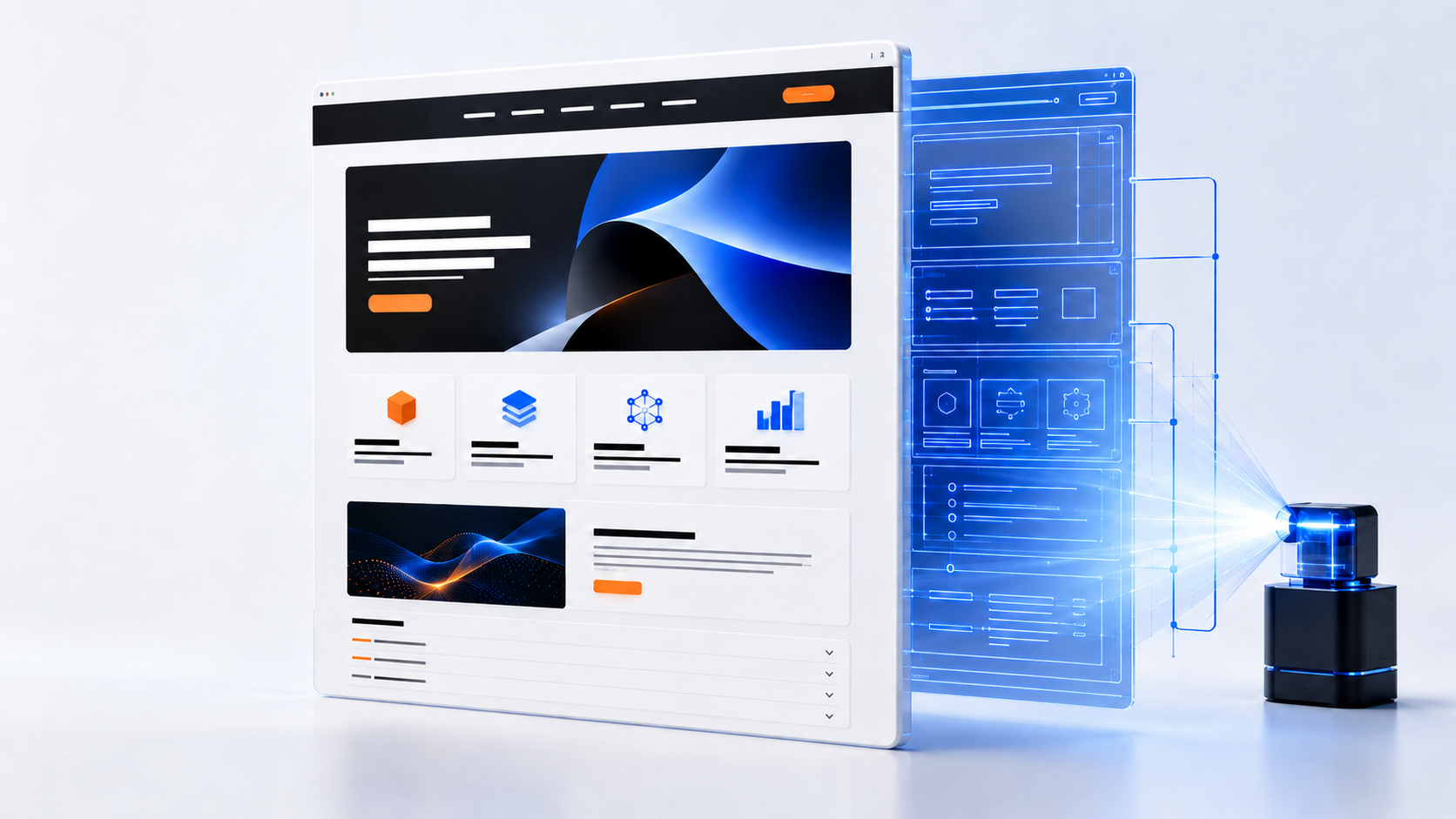
In simple terms, visibility across AI systems means making your business understandable not only to people, but also to AI systems that increasingly decide which organizations become part of search results and AI-generated answers. The logical next question is no longer how organizations optimize another website for another algorithm. It is how they build websites for humans and AI — digital products that communicate knowledge equally well to people, search engines, large language models, and the intelligent systems that are rapidly becoming a new interface to the web.
This direction is also reflected by Google itself. At Google I/O 2026, the company described its AI-powered Search experience as the biggest evolution of Search in more than 25 years, underlining that AI-generated answers are becoming a core part of how information is discovered rather than an experimental feature.
Key Takeaways
- Websites are no longer consumed exclusively by people. They are increasingly interpreted by AI systems before a visitor arrives.
- AI strategic visibility extends beyond traditional SEO by ensuring that organizations can be understood, not just discovered.
- The next generation of websites for humans and AI is designed around knowledge, context, and clarity rather than pages and keywords alone.
- AI optimized websites communicate consistently across search engines, large language models, and emerging AI interfaces.
- Organizations that prepare their digital presence today will be better positioned for the next generation of search and digital discovery.
Websites Were Built for a Different Internet
For most of the web's history, the purpose of a website was remarkably straightforward. Present information → Generate trust → Convert visitors. Search engines acted as intermediaries. Their role was to connect users with the most relevant website, where the actual interaction took place. That model shaped nearly every discipline in digital marketing. Search engine optimization focused on improving rankings, user experience focused on simplifying navigation. Conversion optimization focused on turning visitors into customers. Although these disciplines continue to matter, they were all built around the same assumption: The website is where the conversation begins. AI changes that sequence.
Increasingly, the conversation starts somewhere else. A customer asks ChatGPT for recommendations. Gemini compares providers. Perplexity summarizes an industry. Google AI Mode generates an answer before displaying traditional search results.
The Website Has a New Responsibility
The growing influence of AI does not mean websites are becoming less important. Quite the opposite. As AI-powered search becomes more capable, the website becomes the foundation on which those systems build their understanding of a business. This shift is now reflected in Google's own guidance. In May 2026, Google published its first official documentation explaining how websites should prepare for generative AI features in Search. The recommendations are notable because they reinforce familiar principles—valuable content, clear information architecture, technical accessibility, and trustworthy information—rather than introducing an entirely new optimization discipline.
Whether an AI assistant recommends your services, summarizes your expertise, or references your content depends largely on what it can learn from your digital presence. This represents a fundamental shift. For ages, websites were primarily designed to answer questions once visitors had already arrived. Increasingly, they must answer questions before visitors ever reach them.
Every product description, service page, case study, article, and FAQ contributes to a broader understanding of the business. Individually, these pages communicate information. Together, they communicate expertise. The organizations that recognize this difference first will build an advantage that extends far beyond traditional SEO.
Visibility Is Becoming Understanding
The purpose of SEO has always been to increase visibility. That objective has not changed. The definition of visibility has. For many years, visibility meant appearing on the first page of Google. Success depended on rankings, impressions, click-through rates, and organic traffic. Those metrics remain valuable because search engines continue to play a central role in how information is discovered. SEO therefore remains a fundamental discipline. Organizations still need to ensure that their content can be discovered, crawled, indexed, and ranked effectively.
AI strategic visibility does not replace SEO. It begins where traditional SEO reaches its limit.
Once a website has been discovered, the next question is no longer whether AI systems can find it, but whether they can understand it well enough to recommend it with confidence. However, AI-powered search introduces another layer. Before deciding which sources to reference, large language models attempt to understand what an organization does, how its expertise is structured, and whether the available information appears consistent and trustworthy. This is the difference between visibility and AI strategic visibility.
The distinction is subtle but important. Organizations that are easy to understand become easier to recommend. Increasingly, that recommendation happens before a customer performs a traditional search or visits a website. This is why AI visibility should not be viewed as another marketing metric. It is becoming an indicator of how clearly an organization communicates its knowledge across every interface where information is consumed.

Use Case: Business Context As New Competitive Advantage
One of the biggest misconceptions surrounding AI is that success depends on producing more content. It does not. Organizations rarely struggle because they lack information. They struggle because their knowledge exists in isolation. Products are described on one page, services on another. Industry expertise is buried in blog posts. Case studies tell compelling stories, but remain disconnected from the services they support.
To a human visitor, these gaps may seem insignificant. People naturally connect information. AI systems cannot make the same assumptions. They rely on context.
They look for relationships between products, services, industries, expertise, and outcomes. They attempt to build a coherent picture of the business before deciding whether it is relevant to a particular question. This is where many organizations unintentionally limit their own AI strategic visibility.
Businesses that communicate their expertise as an integrated system are significantly easier for AI systems to understand than businesses that publish isolated pages with little relationship to one another. That is why the conversation is gradually moving beyond content marketing. The real challenge is no longer creating more information. It is creating better context.
How to Build Websites for Humans and AI
This is the point where the discussion moves beyond SEO. The next generation of digital experiences is not defined by new ranking factors or another optimization framework. It is defined by a different design objective. Websites should communicate equally well with every audience consuming their information.
Human visitors should be able to understand
- what a business offers,
- navigate confidently,
- and make informed decisions.
Search engines should be able to
- discover,
- and index the content efficiently.
Large language models should be able to
- interpret expertise,
- connect related concepts,
- and understand how products, services, and knowledge fit together.
These are not competing requirements. They are different perspectives on the same information. That is why we believe the future belongs to websites for humans and AI.
Design remains important. User experience remains important. SEO remains important. But none of these disciplines alone are sufficient if intelligent systems cannot confidently understand what an organization actually does. The organizations that succeed over the next decade will not necessarily build more sophisticated websites. They will build websites that explain themselves more clearly.
AI Native Engineering Is a Design Principle
Every significant technological shift changes the way digital products are built. Responsive Design emerged because users stopped browsing exclusively on desktop computers. Mobile First became essential when smartphones overtook desktop devices. Cloud Native changed how software was developed and deployed. The rise of AI introduces another shift. Not because AI replaces websites, but because websites are no longer consumed exclusively by people. They are interpreted, compared, summarized, and increasingly acted upon by intelligent systems before a human interaction takes place. This requires a different design philosophy.
At Better Technologies, we believe the next generation of digital products should follow a new design principle: AI Native Engineering. It is not a checklist, nor is it another optimization framework. It is a way of thinking about digital products.
The Principle Is Straightforward
Digital products should communicate knowledge clearly to every system that consumes information — from people and search engines to large language models and, increasingly, AI agents capable of acting on behalf of users. And increasingly, it includes AI agents capable of researching, comparing, and acting on behalf of users. The technologies supporting this principle will continue to evolve. This is also why AI Native Engineering should not be confused with implementing individual technologies or following short-lived optimization trends. Google's own guidance emphasizes that long-term visibility is built on strong technical foundations, valuable content, and clear information — not on isolated AI-specific hacks.
New standards will emerge, others will disappear, and implementation details will change over time. The underlying objective, however, remains remarkably stable. Build digital products that are easy to understand. Organizations that achieve this create stronger AI strategic visibility, regardless of which interface becomes dominant in the future.
A Small Example That Illustrates a Much Larger Shift
The transition toward machine-readable knowledge is already becoming visible in practice. Developer and content creator Brycen Wood recently shared in the first quarter of 2026 an experiment that attracted considerable attention within the AI community. Every public page on his website was accompanied by a machine-readable Markdown version alongside the traditional HTML page. The idea was surprisingly simple.
Instead of requiring AI systems to interpret navigation menus, scripts, cookie banners, and other interface elements, they could access the underlying information directly in a clean, structured format. According to his published experience, daily traffic increased from around seven visitors to more than two hundred after introducing this approach. Whether the same outcome can be expected elsewhere is almost beside the point.
The more interesting observation is what the experiment demonstrates. When knowledge becomes easier for machines to interpret, it also becomes easier to discover, reference, and reuse. That principle extends far beyond Markdown itself. It reflects the broader direction in which the web is evolving.
Website Structure Is Becoming a Strategic Decision
For years, website structure was largely discussed as a SEO topic.
- Should important pages be closer to the homepage?
- How many clicks should separate users from key content?
- How should internal links be organized?
These questions remain relevant. Their importance has simply expanded. Structure is no longer only about helping search engines crawl a website. It is about helping intelligent systems understand relationships. How products connect to services. How services connect to expertise. How expertise is supported by case studies, articles, and customer outcomes. These relationships create context → Context creates understanding → Understanding creates visibility. This is why website architecture is becoming a strategic business decision rather than a purely technical discipline. We explore this perspective in greater depth in Website Architecture, where information architecture is examined through the lens of AI and long-term digital relevance.
The Website Is Becoming an Operating System for Knowledge
Once websites are viewed as connected knowledge rather than isolated pages, another shift naturally follows. Organizations stop managing content page by page. They begin managing knowledge as a connected system.
- Products support services
- Services reinforce expertise
- Articles answer customer questions
- Case studies validate capabilities
- Documentation strengthens authority
Every digital asset contributes to a single representation of the business. This is a fundamentally different way of thinking about websites. Rather than acting as digital brochures, they become the central operating layer for an organization's knowledge. This idea forms the foundation of Website as an Operating System, where we explore how websites evolve into connected business platforms rather than collections of independent pages. Looking even further ahead, this evolution extends beyond websites altogether.
Conclusion
The conversation about AI often focuses on models, tools, and interfaces. Those technologies will continue to evolve. The more enduring question is different. How should digital products be built in a world where people are no longer the only audience? That is the question every organization should be asking. The answer is unlikely to be found in another SEO tactic or another AI tool. It begins with a different understanding of what a website has become. A website is no longer simply a place where visitors consume information. It is the public representation of an organization's knowledge. That knowledge must be understandable to customers, to search engines, to large language models, and to the intelligent systems that increasingly shape how information is discovered.
This is why AI strategic visibility is becoming a strategic capability rather than a marketing initiative. It is not about optimizing for one platform. It is about building digital products that remain understandable as technology continues to change. The next generation of websites will not be defined by how they look, they will be defined by how well they communicate knowledge. That is why the future belongs to websites for humans and AI. The website is becoming the public representation of an organization's knowledge.
FAQ
What is visibility across AI systems?
AI strategic visibility is an organization's ability to be understood, trusted, and recommended by AI systems. Rather than focusing exclusively on search rankings, it ensures that products, services, expertise, and business knowledge can be interpreted across search engines, large language models, AI assistants, and future intelligent interfaces.
What does AI visibility mean?
AI visibility describes how effectively AI systems can discover, interpret, and reference an organization. It extends beyond traditional search visibility by emphasizing context, relationships between information, and the overall clarity of a company's digital knowledge.
Why should I invest in AI strategy?
AI increasingly influences how customers discover businesses and evaluate potential partners. Investing in AI strategy helps organizations prepare their digital presence for AI-powered search experiences while strengthening long-term digital visibility.
How can AI improve strategic visibility in business operations?
AI improves strategic visibility when organizations structure and communicate their knowledge consistently. Clear business context makes it easier for AI systems to retrieve relevant information, recommend expertise, and connect products and services across different interfaces.
Where can I find AI solutions for strategic visibility in marketing?
The most sustainable approach combines content strategy, website architecture, structured knowledge, and AI-ready digital products. Long-term visibility is created by building connected knowledge rather than relying on isolated optimization techniques.
What are the top AI tools for enhancing strategic visibility?
There is no single tool that creates AI strategic visibility. Organizations benefit from combining strong content management, structured data, analytics, AI-assisted workflows, and a website architecture that allows both people and AI systems to understand the business consistently.